
━━ PSYCHOSOCIAL SAFETY
Psychosocial Safety: Understanding the New Landscape of Workplace Harm
This hub exists to help leaders understand the landscape, the obligations, and the shifts reshaping the modern workforce and how to respond with clarity, confidence and care.
Psychosocial safety is now one of the most significant responsibilities facing Australian workplaces and one of the least understood.
As legislation evolves, incidents escalate faster and employees carry more unseen pressure than ever before, organisations are being forced to rethink their entire approach to harm, risk and crisis response.
━━ THE DEFINITION
What is Psychosocial Safety?
Psychosocial safety refers to the protection of employees from harm that affects their mental, emotional or psychological wellbeing. This includes:
aggression, threats or violence
stalking or domestic spillover
conflict or toxic behaviours
cumulative stress and burnout
un-managed workloads or poor support
exposure to traumatic events
reputational or public-facing pressure
These are not “soft issues” - they are defined as hazards under national WHS laws and they require clear identification, classification, escalation and response.
“Mental health conditions now account for 12% of all serious workers’ compensation claims in Australia - the highest proportion ever recorded.”
━━ TIPPING POINT
Why Psychosocial Harm Escalates So Quickly
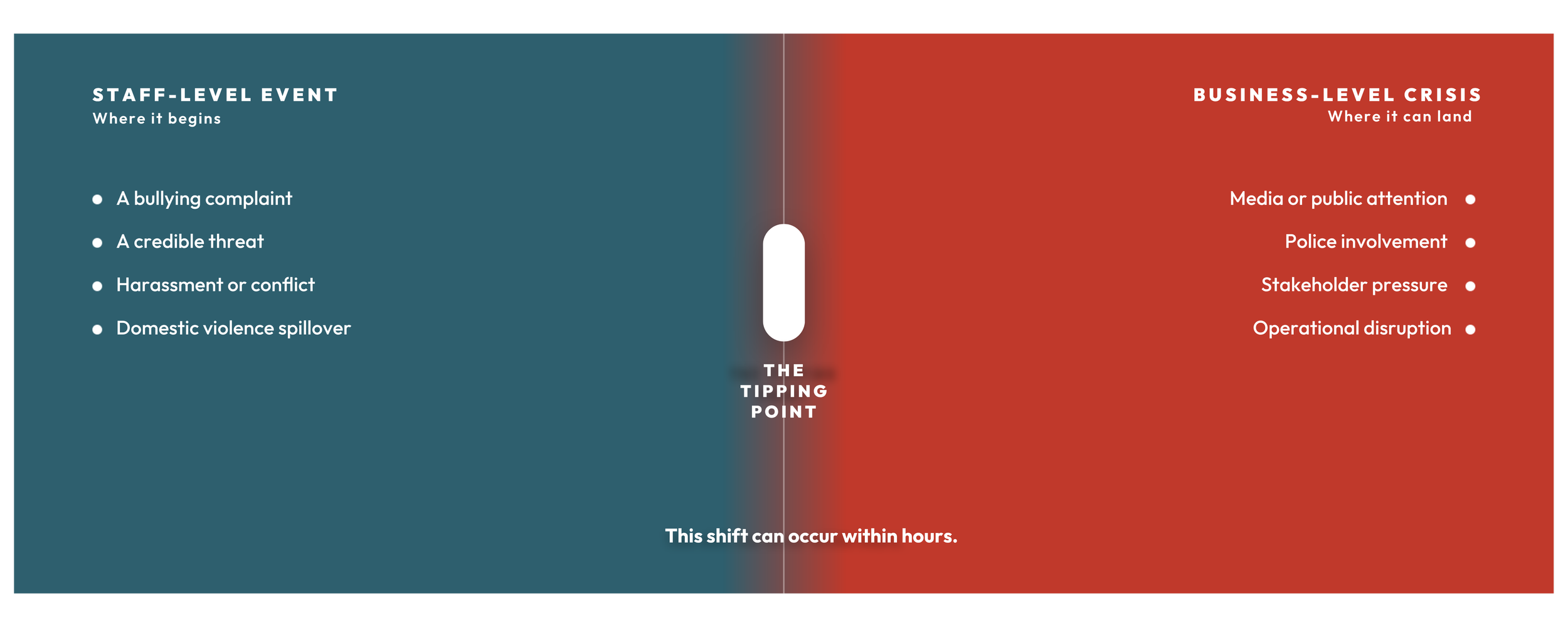
Psychosocial incidents rarely begin at the surface level. They build quietly - often invisibly - until they spill over into the workplace. By the time leaders become aware, the situation is usually:
emotionally charged
legally sensitive
reputationally fragile
operationally disruptive
This is why psychosocial safety requires more than awareness; it requires early recognition, structured escalation and timely intervention.
This is the tipping point.
━━ THE NEW EMPLOYER DUTY OF CARE
Boards · Executives · HR Teams now share this obligation equally.
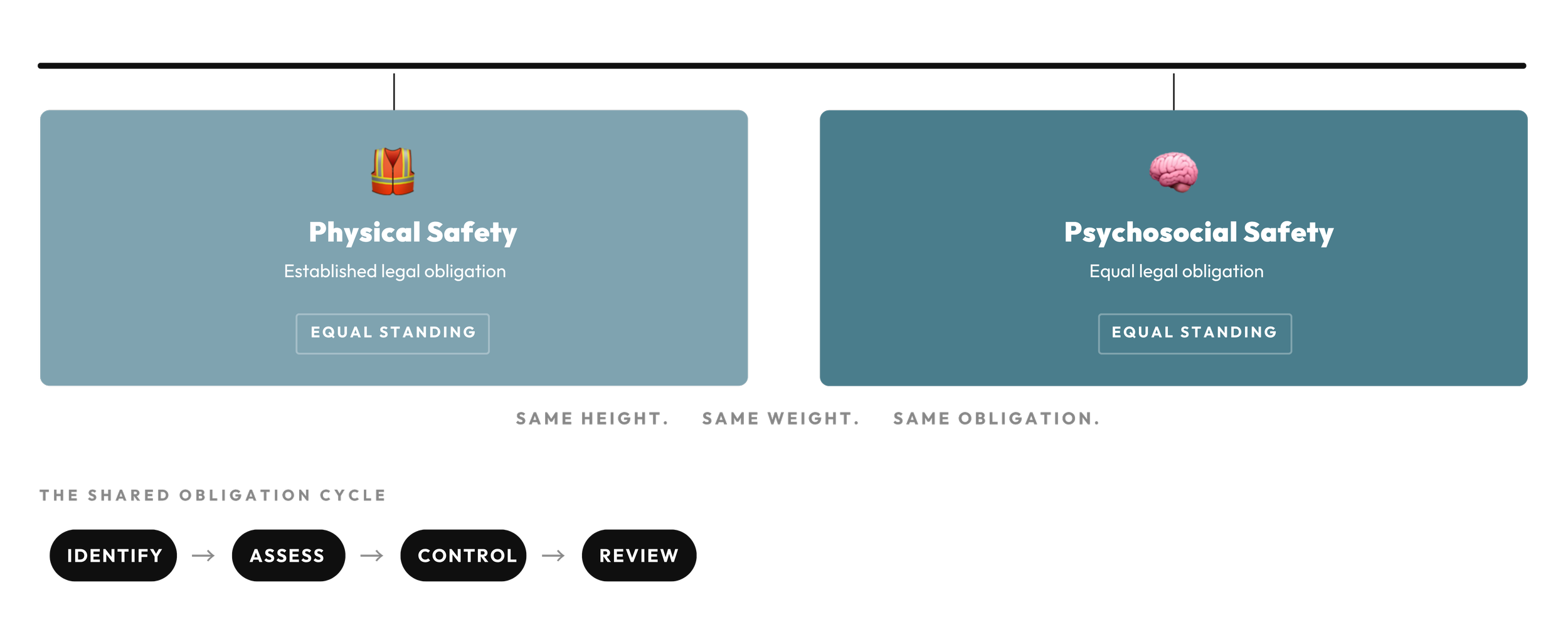
Alongside. Not beneath.
━━ INSIDE THE INCIDENT
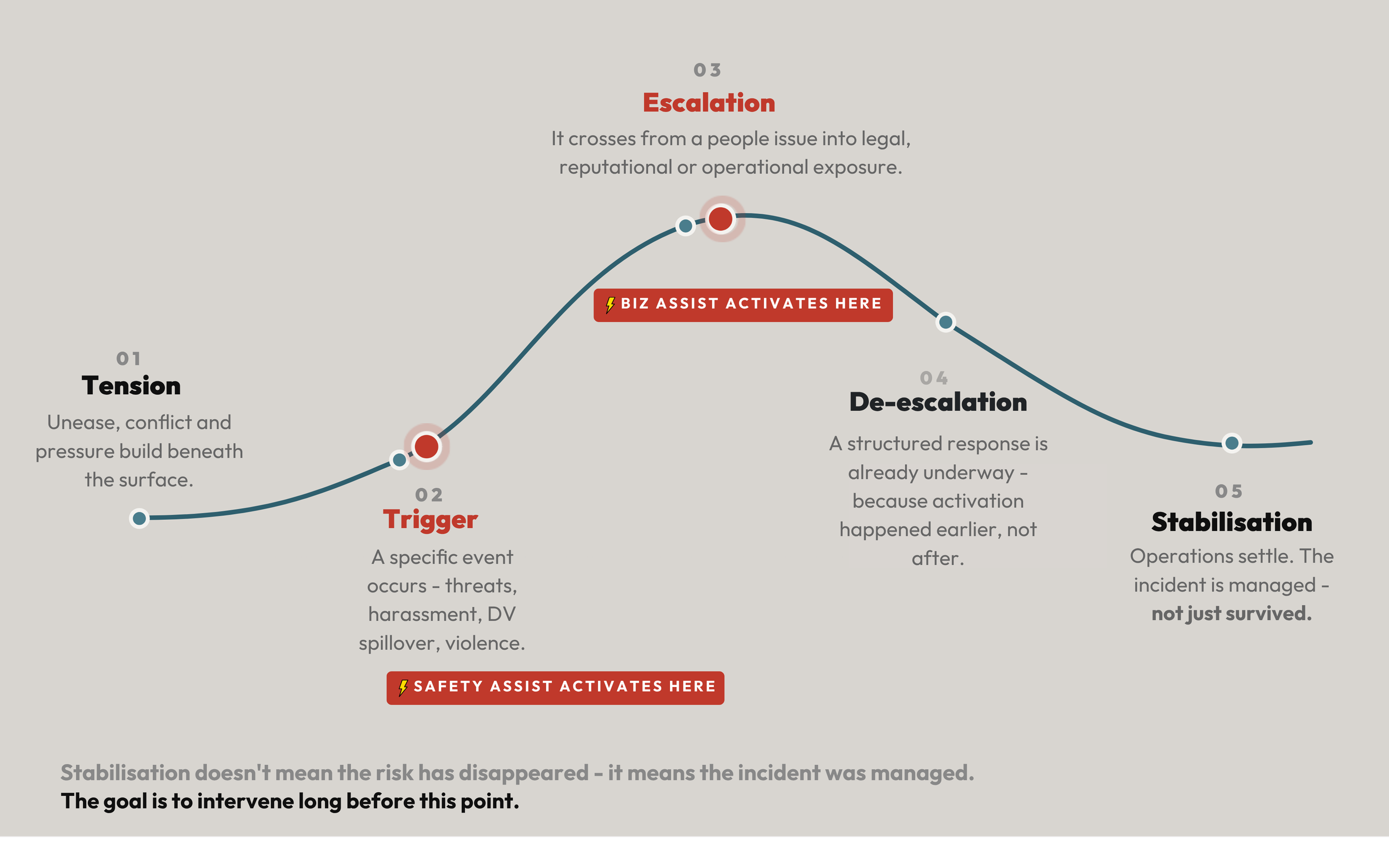
The Psychosocial Safety Escalation Curve
Psychosocial harm doesn't appear out of nowhere - it builds. Every incident moves through these stages. The earlier the response, the less ground is lost.
━━ THE FRAMEWORK
The Psychosocial Safety Framework
Psychosocial safety isn't a single action - it's a closed-loop framework. The standard WHS cycle is Identify → Assess → Control → Review.
We add the stage most workplaces are missing: Response - the real-time support required when an incident actually occurs.
01 · IDENTIFY
Spot the early signs.
Listening to workers · Observing behaviour · Reviewing records & patterns · Risk screening tools
02 · ASSESS
Establish severity and exposure.
What could happen · Who's at risk · How severe · How often
03 · CONTROL
Eliminate or reduce the risk.
Policy · Environmental design · Workflow changes · Leadership intervention
04 · RESPONSE — our added stage
Act when harm occurs - not if, but when.
Safety Assist is a risk control lever and activates for aggressor-based incidents - threats, harassment, stalking, DV spillover.Biz Assist activates for the organisational fallout, psychosocial or otherwise.
Burnout and workload sit under Control, not Response.
05 · REVIEW
Close the loop.
Test controls · Update for new conditions · Learn from incidents · Consult workers

━━ WHY NOW
Why This Is Happening Now
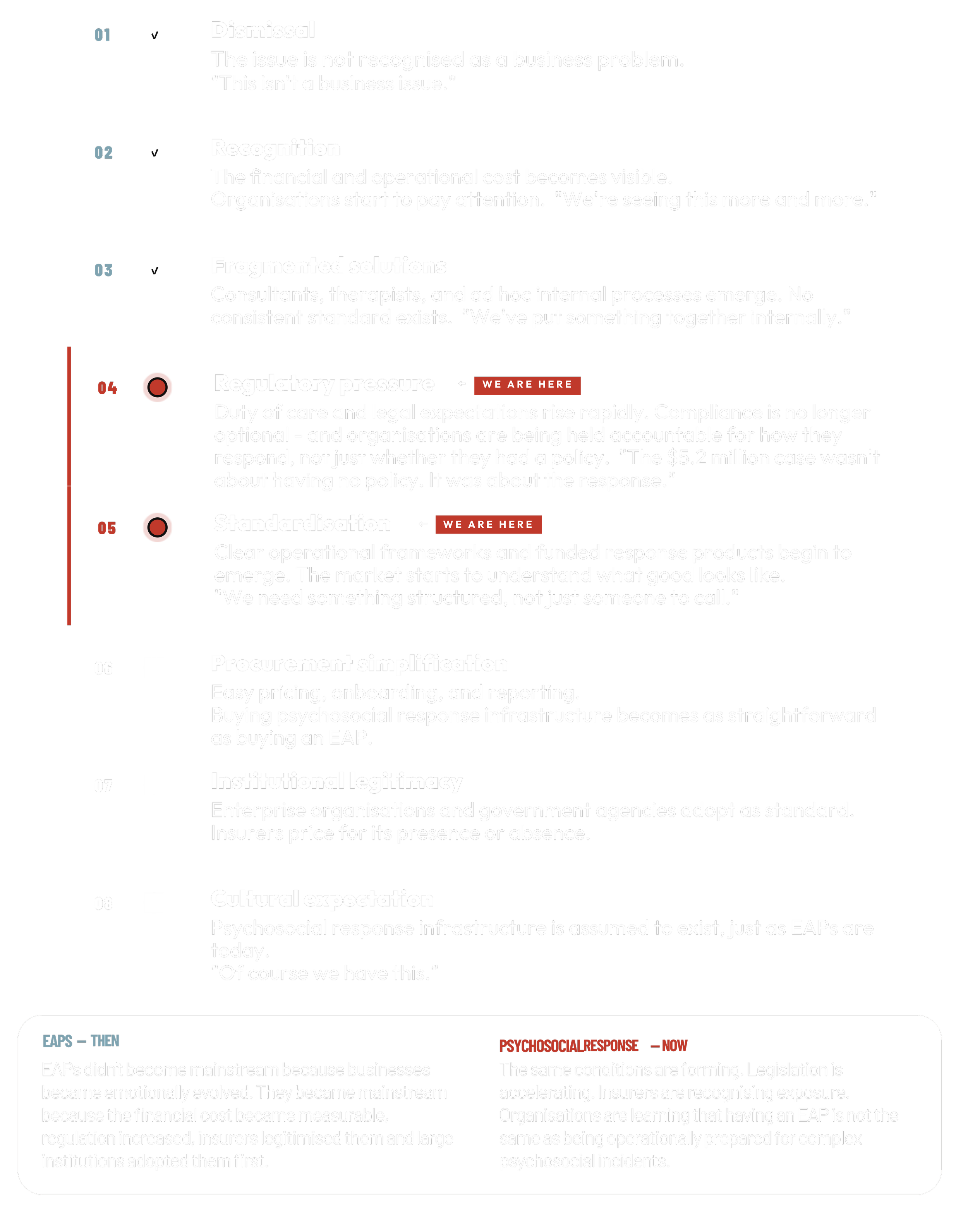
Psychosocial safety isn't a new idea - but operational response to it is still maturing. The pattern is a familiar one.
Employee Assistance Programs followed the same path decades ago. They didn't become standard workplace infrastructure because organisations became more emotionally aware. They became standard because the financial cost became measurable, legislation caught up, insurers recognised the exposure, and large institutions adopted them first.
Psychosocial response is moving through the same curve.
We're currently sitting between stages three and five: fragmented solutions are already emerging, regulatory pressure is accelerating fast, and the first standardised response frameworks are starting to appear.
The organisations building this capability now are the ones who won't be caught unprepared when the category matures into cultural expectation - the same way EAPs eventually did.
━━ PSYCHOSOCIAL RESOURCES
Psychosocial Safety Tools, Checklists & Frameworks
A simple, actionable checklist to determine whether your organisation is meeting psychosocial safety obligations - including hazard identification, worker consultation, reporting pathways and crisis response readiness.
A practical resource supporting organisations to understand domestic violence spillover: early indicators, reporting challenges (26 incidents before reporting) and employer WHS duties.
A one-page briefing on immediate actions to take after aggression, assault or threat - aligned with WHS legislation and early-response best practice.
A quick-reference guide to help managers recognise psychosocial hazards such as workplace violence, threats, harmful behaviours, harassment, domestic spillover and critical incidents.
A simplified overview of the Australian regulations under WHS Amendment: Managing the Risks of Psychosocial Hazards (F2024L01380) - outlining employer duties, high-risk psychosocial hazards and what constitutes “reasonably practicable” control.