
The Fifth Stage: Why Psychosocial Risk Needs More Than Awareness
The warning is here - and it’s human.
When AREEA released its Evolution of Work 2025 report, one finding stood out above all: Psychosocial risk is now the single biggest challenge facing Australia’s resources and energy sector - but one of the least understood and least resourced. It’s a stark reminder that the biggest hazards we face today aren’t mechanical, operational, or environmental. They’re human.
Mining and energy companies have spent decades engineering physical safety into their DNA - “zero harm” culture, hierarchy of controls, risk matrices, and continuous improvement cycles. But psychosocial risk operates differently. It’s not a trip hazard or confined space breach. It’s aggression, burnout, exclusion, harassment, grief, or trauma - and unlike physical risks, it spreads through people, culture, and brand reputation. And right now, our frameworks are still built for a different era. The problem: our systems are still too soft.
We’ve made enormous progress in raising awareness and educating for prevention. Leaders talk openly about mental health. Boards reference psychosocial safety in annual reports. Organisations run wellbeing programs and resilience workshops. But awareness isn’t capability.
Most businesses still rely on soft tools - training, coaching, EAP lines - to handle what are increasingly hard realities:
Threats or violence toward staff
Domestic violence spillovers
Online bullying and harassment
Traumatic incidents witnessed at work
These aren’t theoretical risks. They’re crisis events and the moment they occur, the burden shifts to untrained HR teams or operational managers to “do their best.” What AREEA’s report reveals is not a lack of care - but a lack of structure. The industry knows psychosocial risk is real. It just hasn’t built the systems to handle it.
Psychosocial harm requires both immediate incident response (Safety Assist) and business-level crisis escalation management (Biz Assist).
A familiar pattern: We’ve been here before.
If this feels like déjà vu, that’s because it is. In the early 2010s, Australia underwent a transformation in workplace health and safety (WHS). New laws forced companies to treat safety as a proactive, integrated system rather than a reactive process. It took years and a combination of:
Compounding claims,
Regulator pressure, and
Insurance escalation
- before safety matured from compliance to culture. Before that shift, physical injuries were “unfortunate accidents.” After it, they became foreseeable failures of duty of care.
That’s exactly where psychosocial risk sits today.
The groundwork has been laid - through new WHS amendments, Safe Work Australia guidelines, and AREEA’s own reporting - but the systems are still reactive, prevention-heavy, and operationally untested. We’re in the pre-response era of psychosocial safety. And just like 2010, it’s only a matter of time before the world catches up.
The missing stage in ‘best practice’.
Australia’s psychosocial hazard framework currently follows four stages:
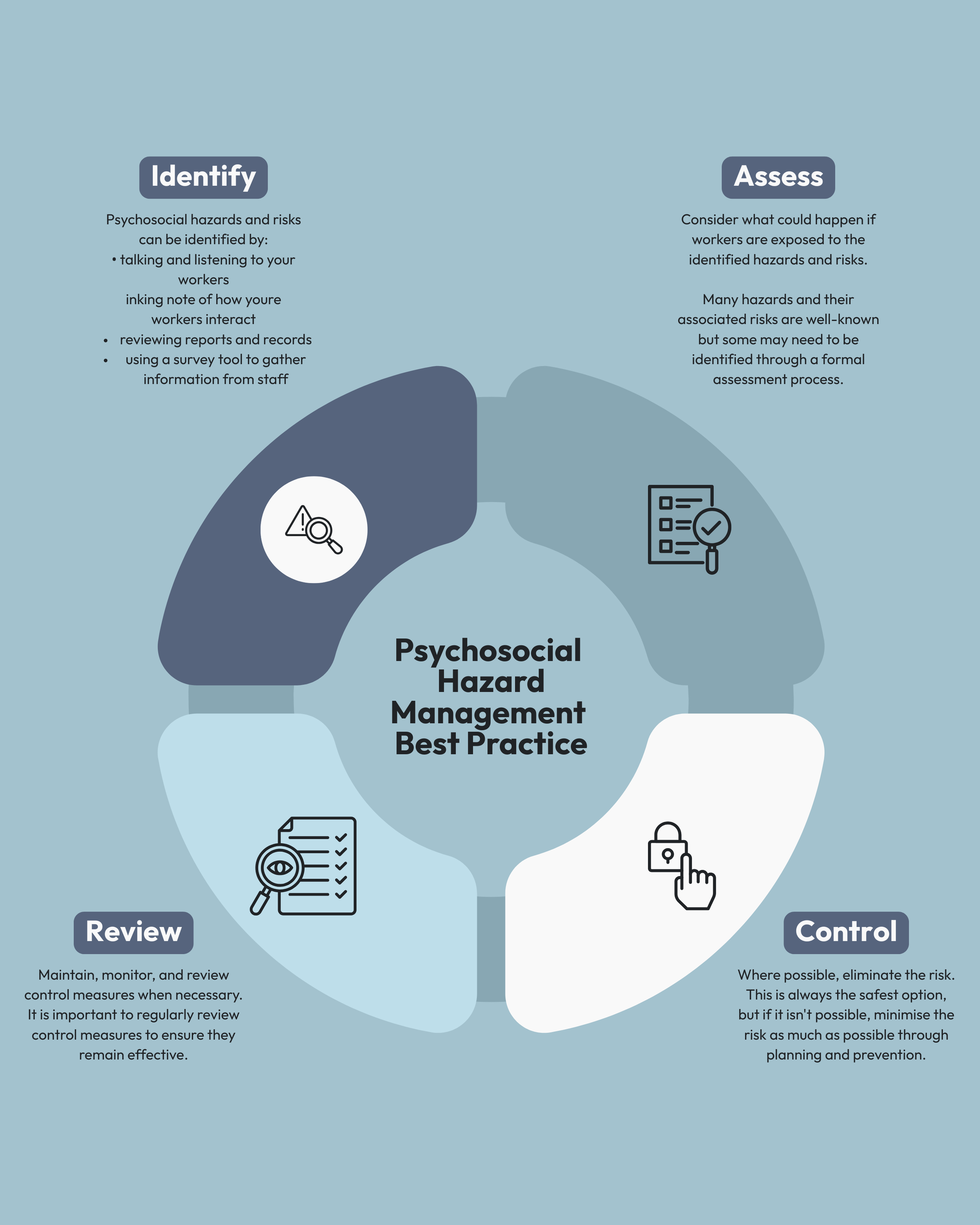
*Gap: No mechanism for response during or immediately after an incident.
It’s logical, but it assumes incidents are preventable - and that prevention works 100% of the time. The problem? When controls fail, there’s no guidance on what to do next.
No defined process for crisis response. No embedded system for protection and communication. No framework for how to manage the fallout in those crucial first 48 hours. That’s where the additional stage belongs.
Introducing Stage 4: Response.
At VUCA Risk, we believe psychosocial safety must evolve to include an extra stage, Response:
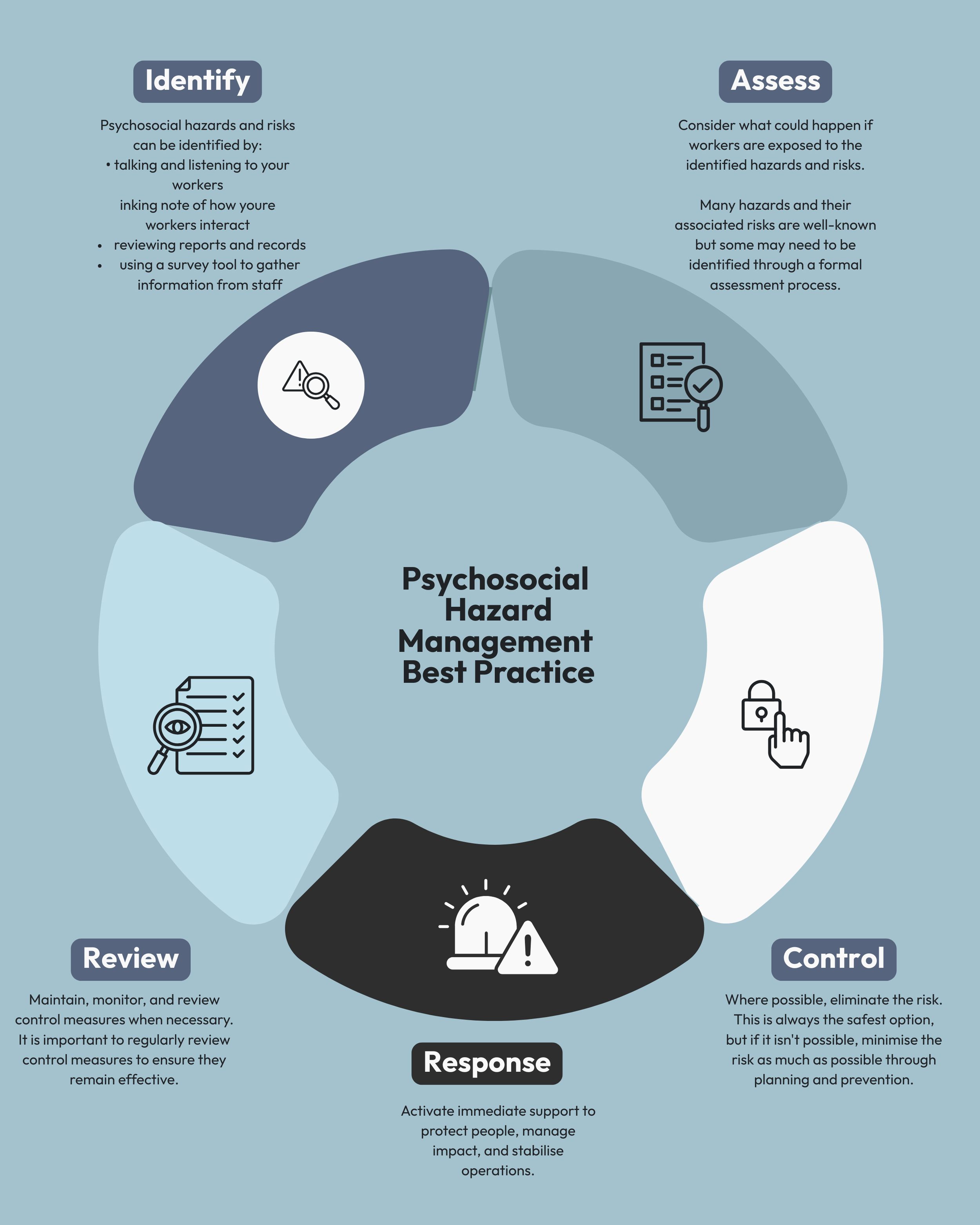
*Bridge: Adds real-time capability to protect people and reputation before escalation.
This isn’t just a procedural tweak - it’s the missing link between prevention and recovery. Adding Response closes the most dangerous gap in current frameworks - the real-world moments when leaders, HR or site managers are left to improvise during a live crisis. Because psychosocial harm doesn’t wait for a “review of controls.”
It happens in real time.
When harm escalates, organisations need Biz Assist crisis activation to protect reputation and operations.
Why Psychological First Aid isn’t enough.
Most organisations respond to incidents with Psychological First Aid (PFA) - a well-intentioned but limited model designed for emotional triage, not operational control.
PFA offers empathy, not coordination.
It stabilises the individual but ignores the system.
It doesn’t manage family safety, legal exposure, communications, or media pressure.
It doesn’t protect the employer or the brand.
Psychosocial crises need structured intervention - a co-ordinated response that combines emotional care, logistical control, and organisational protection. That’s why we built Safety Assist and Biz Assist - to make elite crisis response systems (the kind once reserved for corporations with million dollar retainers) accessible to every business. At the end of the day, in 2025, protection shouldn’t be a privilege.
Beyond compliance: a moral duty.
AREEA’s report doesn’t just highlight psychosocial risk. It also underscores the growing focus on diversity, inclusion, and leadership culture. The shift toward trust-based, people-first leadership is real - but it also introduces new complexity.
Diversity frameworks are excellent at raising awareness and preventing harm, but they rarely articulate what to do when prevention fails. When bullying, harassment, or discrimination occurs, having a defined response process ensures consistency, fairness, and credibility. It transforms response from a legal defence into a leadership act. And at a board level, it demonstrates that safety and equity aren’t just legislative obligations - they’re moral commitments.
Trust is built not when things go right, but when leaders act decisively when they don’t.
What we can do about it.
The evidence is clear:
Psychosocial risk is rising faster than organisational capability.
Hybrid work and decentralised leadership have expanded exposure.
Regulators and insurers are starting to demand measurable readiness, not awareness.
So where do we go from here?
Acknowledge response as part of prevention. You can’t claim to “control” risk if you can’t manage it when it breaks containment.
Operationalise the fifth stage. Embed crisis management protocols, insurer-backed response systems, and clear escalation points within your psychosocial framework.
Reframe duty of care. The law may define the minimum. Leadership defines the standard.
Every board should treat psychosocial response not as a compliance box, but as a moral line in the sand.
The future of safety is already unfolding.
Just as 2010 redefined what physical safety meant, the next decade will redefine what psychosocial safety requires. The companies who move early - who build readiness into their DNA now - will be the ones that shape the standard for everyone else.
Prevention without response isn’t protection. It’s hope. And hope is not a strategy.
The missing stage of psychosocial safety is response.
And it’s time to build it in.
Explore how Safety Assist supports employees and how Biz Assist protects the business when psychosocial incidents escalate.
Download the full report here